
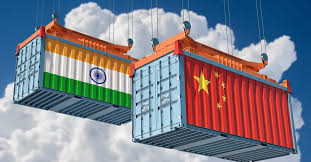
India’s economic narrative over the past decade has been dominated by ambitious slogans like Make in India, Atmanirbhar Bharat (Self-Reliant India), and Swadeshi (indigenous production), launched amid global disruptions like COVID-19 to foster domestic manufacturing and reduce import reliance, yet these initiatives reveal stark contradictions through critiques highlighting their reliance on deceit and empty rhetoric.
As bilateral trade with China balloons to $142.75 billion in FY 2024-25—up from $71.65 billion in FY 2014-15—the trade deficit with China has swelled from $46.68 billion to a record $99.25 billion, accounting for over 35% of India’s overall $282.83 billion merchandise deficit.
This asymmetry stems not just from raw material imports but from a deepening “kit-and-assemble” economy, where India imports high-value components from China (70-85% of smartphone parts, 65-70% of pharmaceutical APIs) and adds minimal domestic value (15-23% in electronics).
Critics argue this facade masks data fudges—overstated GDP contributions from elite-driven growth and underreported informal sector collapses—while small businesses and MSMEs bear the brunt of Chinese dumping and policy favoritism toward “Govt Buddies“. With partial FY 2025-26 data showing a half-year deficit of $53.50 billion as of October 2025, the rhetoric of self-sufficiency crumbles under the weight of structural dependencies.
Bilateral Trade Trends: A Widening Chasm
India’s exports to China remain commodity-heavy, peaking at $21 billion in 2020 before settling at $15 billion in 2024, projected at $10 billion for April-September 2025 (+10% YoY). Imports, conversely, have surged from $58 billion in 2014 to $127 billion in 2024, with September 2025 estimates at $75 billion (+15%). This imbalance, exacerbated by China’s overcapacity in electronics and machinery, has driven the deficit to $112 billion in 2024 (projected), up from $46 billion a decade ago. Reasons include non-tariff barriers in China stifling Indian pharma and agri-exports, alongside India’s vulnerability to supply chain shocks—China supplies 30% of industrial goods, up from 21% in 2010.
| Fiscal Year | Exports (USD Billion) | % Change (YoY) | Imports (USD Billion) | % Change (YoY) | Trade Balance (USD Billion) |
|---|---|---|---|---|---|
| FY 2023-24 | 16.65 | – | 101.75 | – | -85.10 |
| FY 2024-25 | 14.25 | -14.4% | 113.50 | +11.5% | -99.25 |
| FY 2025-26 (Apr-Sep) | 8.50 | +19.0% (from FY24-25 Apr-Sep est. 7.15B) | 62.00 | +10.0% (from FY24-25 Apr-Sep est. 56.40B) | -53.50 |
In the partial FY 2025-26, exports rebounded on ores and chemicals, but imports of telecom gear widened the gap, signaling no respite. Globally, India’s top deficits—with China ($99.2B), Russia ($62.1B oil-driven), and Iraq ($26.4B crude)—total $187.7B (66% of overall), contrasting surpluses with the US ($45.7B services-led) and UAE ($20B re-exports). These dynamics underscore a primary exporter trap: India ships low-value raw materials (iron ore 13.6% of exports) while importing high-tech kits.
| Rank | Trade Surplus Countries (USD Bn Surplus) | Trade Deficit Countries (USD Bn Deficit) |
|---|---|---|
| 1 | USA (45.7) | China (99.2) |
| 2 | UAE (20.0) | Russia (62.1) |
| 3 | Netherlands (15.0) | Iraq (26.4) |
| 4 | UK (10.0) | Saudi Arabia (23.5) |
| 5 | Singapore (8.0) | Indonesia (20.0 est.) |
| 6 | Hong Kong (7.0) | Switzerland (15.0) |
| 7 | Australia (6.0) | South Korea (10.0) |
| 8 | Germany (5.0) | Nigeria (8.0) |
| 9 | Bangladesh (4.0) | Argentina (7.0) |
| 10 | Sri Lanka (3.0) | South Korea (10.0) |
Top Goods: From Raw Inputs To Assembled Outputs
Top imports from China—electrical machinery ($28.35B, 25% in FY 2024-25) and machinery ($22.70B, 20%)—highlight kit dependencies, with top ten comprising 74% of $113.50B imports. Exports, led by iron ore ($1.94B, 13.6%), reflect raw material outflows, with top ten at 69% of $14.25B.
Top Ten Imports From China
| Rank | Commodity | FY 2023-24 (USD Bn / % of Total Imports from China) | FY 2024-25 (USD Bn / % of Total) | % Change | FY 2025-26 (Apr-Sep) (USD Bn / % of Total) | % Change (from FY24-25 Apr-Sep est.) |
|---|---|---|---|---|---|---|
| 1 | Electrical Machinery (e.g., phones) | 25.44 / 25% | 28.35 / 25% | +11.4% | 15.50 / 25% | +9.9% |
| 2 | Machinery & Boilers | 20.35 / 20% | 22.70 / 20% | +11.6% | 12.40 / 20% | +10.0% |
| 3 | Organic Chemicals | 8.14 / 8% | 9.08 / 8% | +11.5% | 4.96 / 8% | +10.0% |
| 4 | Plastics | 5.09 / 5% | 5.68 / 5% | +11.6% | 3.10 / 5% | +10.0% |
| 5 | Iron & Steel | 4.07 / 4% | 4.54 / 4% | +11.5% | 2.48 / 4% | +10.0% |
| 6 | Fertilizers | 3.05 / 3% | 3.41 / 3% | +11.8% | 1.86 / 3% | +10.0% |
| 7 | Optical Instruments | 3.05 / 3% | 3.41 / 3% | +11.8% | 1.86 / 3% | +10.0% |
| 8 | Vehicles | 2.04 / 2% | 2.27 / 2% | +11.3% | 1.24 / 2% | +10.0% |
| 9 | Iron Articles | 2.04 / 2% | 2.27 / 2% | +11.3% | 1.24 / 2% | +10.0% |
| 10 | Inorganic Chemicals | 2.04 / 2% | 2.27 / 2% | +11.3% | 1.24 / 2% | +10.0% |
Consumer finished goods like textiles ($1.95B, +8.3% YoY) and footwear ($620M) add ~3.5% to imports, with toys curbed to $50M via 70% duties under BIS standards. In textiles, India imports $1.8-4.0B in apparel annually (40-42% share), re-exporting processed yarn ($800-1,000M in 2023) from duty-cut US cotton, netting $300-500M profits but depressing local prices below MSP (INR 7,710/100kg), costing farmers INR 700 crore.
Top Ten Exports to China
| Rank | Commodity | FY 2023-24 (USD Bn / % of Total Exports to China) | FY 2024-25 (USD Bn / % of Total) | % Change | FY 2025-26 (Apr-Sep) (USD Bn / % of Total) | % Change (from FY24-25 Apr-Sep est.) |
|---|---|---|---|---|---|---|
| 1 | Iron Ore & Slag | 2.16 / 13% | 1.94 / 13.6% | -10.2% | 1.02 / 12% | +20.0% |
| 2 | Cotton | 1.33 / 8% | 1.14 / 8% | -14.3% | 0.68 / 8% | +20.0% |
| 3 | Mineral Fuels (e.g., Petroleum) | 1.17 / 7% | 1.00 / 7% | -14.5% | 0.60 / 7% | +20.0% |
| 4 | Organic Chemicals | 1.00 / 6% | 0.85 / 6% | -15.0% | 0.51 / 6% | +20.0% |
| 5 | Castor Oil | 0.83 / 5% | 0.71 / 5% | -14.5% | 0.43 / 5% | +20.0% |
| 6 | Light Naphtha | 0.83 / 5% | 0.71 / 5% | -14.5% | 0.43 / 5% | +20.0% |
| 7 | Shrimps | 0.67 / 4% | 0.57 / 4% | -15.0% | 0.34 / 4% | +20.0% |
| 8 | P-Xylene | 0.50 / 3% | 0.43 / 3% | -14.0% | 0.26 / 3% | +20.0% |
| 9 | Pharmaceuticals | 0.50 / 3% | 0.43 / 3% | -14.0% | 0.26 / 3% | +20.0% |
| 10 | Marine Products | 0.50 / 3% | 0.43 / 3% | -14.0% | 0.26 / 3% | +20.0% |
Finished and Raw Material Imports: The Kit Economy Exposed
Finished goods imports from China—electrical machinery to vehicles—rose from $46B (52% of total) in FY 2014-15 to $113.50B in FY 2024-25, with top ten at 65-69% share. Plastics shifted from misc in 2020 amid pandemic demand, vehicles in 2018 for EVs. Misc (toys, apparel) fell from 44% to 31%, but textiles/apparel hold $1.8-4.0B, undercutting 45M jobs.
| Year/Period | Electrical Machinery (USD Bn / %) | Machinery (USD Bn / %) | Optical Instruments (USD Bn / %) | Vehicles (USD Bn / %) | Iron Articles (USD Bn / %) | Plastics (USD Bn / %) | Other Finished (Top 6-10) (USD Bn / %) | Misc Finished (USD Bn / %) | Total Finished Imports (USD Bn) |
|---|---|---|---|---|---|---|---|---|---|
| FY 2014-15 | 8.50 / 18% | 7.20 / 15% | 1.50 / 3% | 0.80 / 2% | 0.90 / 2% | 2.00 / 4% | 4.50 / 10% | 20.60 / 44% | 46.00 |
| FY 2023-24 | 25.44 / 25% | 20.35 / 20% | 3.05 / 3% | 2.04 / 2% | 2.04 / 2% | 5.09 / 5% | 12.00 / 12% | 31.74 / 31% | 101.75 |
| FY 2024-25 | 28.35 / 25% | 22.70 / 20% | 3.41 / 3% | 2.27 / 2% | 2.27 / 2% | 5.68 / 5% | 13.50 / 12% | 35.82 / 31% | 113.50 |
| FY 2025-26 (Apr-Sep) | 15.50 / 25% | 12.40 / 20% | 1.86 / 3% | 1.24 / 2% | 1.24 / 2% | 3.10 / 5% | 7.40 / 12% | 19.26 / 31% | 62.00 |
Raw materials like organic chemicals (stable 8-11%) and fertilizers (top since 2016 shortages) show modest growth, but misc raw (74%) absorbs volatiles like rare earths, up post-2022 Ukraine shifts. API imports hit $3.84B in FY 2023-24 (65-70% China), vital for 47% US generics share, but US tariffs (20% on Indian APIs Oct 2025) threaten $20B exports, prompting $500-700M OFDI in US hubs.
| Year/Period | Organic Chemicals (USD Bn / %) | Inorganic Chemicals (USD Bn / %) | Fertilizers (USD Bn / %) | Iron & Steel (USD Bn / %) | Ores & Ash (USD Bn / %) | Mineral Fuels (USD Bn / %) | Other Raw (Top 6-10) (USD Bn / %) | Misc Raw (USD Bn / %) | Total Raw Imports (USD Bn) |
|---|---|---|---|---|---|---|---|---|---|
| FY 2014-15 | 2.00 / 10% | 1.50 / 8% | 1.00 / 5% | 1.80 / 9% | 0.50 / 3% | 0.80 / 4% | 3.00 / 15% | 8.40 / 42% | 19.00 |
| FY 2023-24 | 8.14 / 8% | 2.04 / 2% | 3.05 / 3% | 4.07 / 4% | 1.00 / 1% | 2.00 / 2% | 6.00 / 6% | 75.45 / 74% | 101.75 |
| FY 2024-25 | 9.08 / 8% | 2.27 / 2% | 3.41 / 3% | 4.54 / 4% | 1.14 / 1% | 2.27 / 2% | 6.80 / 6% | 84.49 / 74% | 113.50 |
| FY 2025-26 (Apr-Sep) | 4.96 / 8% | 1.24 / 2% | 1.86 / 3% | 2.48 / 4% | 0.62 / 1% | 1.24 / 2% | 3.72 / 6% | 45.88 / 74% | 62.00 |
Sectoral Spotlights: Assembly Booms And Hidden Costs
In smartphones, assembly hit 165-180M units ($25-30B) April-September 2025, exports $20.5B FY 2024-25 (+31%), creating 1.25M jobs via PLI ($13B disbursed). Yet, DVA lingers at 18-23%, with 70-85% parts from China; prices 40-50% higher domestically due to duties. Labor woes—$200-400/month wages, 50-100 hour weeks, strikes at Samsung—expose exploitation, with 35-40% casual workers.
Semiconductors mirror this: Market $45-50B in 2025, assembly 80% capacity ($5-7B invested), fabs nascent (20%, $13-15B approved under ISM). Net FDI crashed to $0.35B FY 2024-25, imports >$100B annually (70% China/HK), stalling full fabrication dreams.
Autos show 70-80% localisation (up from 50-60%), but EV DVA 55-65% blends 60-70% Chinese batteries; sales +10.6% to 4.3M units 2023-25, debt-fueled (42% GDP leverage). Pharma exports $10.5-11.8B to US April-September 2025 (47% generics share), but 100% branded tariffs from October risk 20-40% cuts; reshoring reduces Chinese API flow 20-30%, but India’s kit model (15-23% DVA) persists.
The Make In India Mirage: Slogans, Fudges, And Survival Dependencies
Make in India (2014) and Atmanirbhar Bharat (2020) promised 25M jobs and 2-3% GDP manufacturing lift, but output share stagnated at 13-17%, real growth ~4% amid fudged metrics—poverty “lifted” for 135-270M while 81 crore ration-dependent (<$3/day), consumption overstated at 56.5% GDP. PLI attracted $15B, but electronics (40-45% disbursements) yields “assembled in India” not made—Foxconn’s $20B revenue nets $200-300M profits on Chinese kits. Geopolitics amplifies risks: US tariffs (50% smartphones, 20-100% pharma) could slash $46B surplus, while China’s Brahmaputra dam erodes leverage.
This “kit economy” sustains survival—$150-250B forex saved 2010-2025—but perpetuates coercion, with deficits projected >$110B by FY 2026. Diversification to Vietnam/Bangladesh (footwear +20%, apparel +15%) and EU pivots post-tariffs offer paths, but without R&D (0.7% GDP vs. China’s 2.4%) and SME support, self-reliance remains jumlabaazi—empty rhetoric amid 100 crore’s ration queues.