Global Warming Doomsdayers Menace
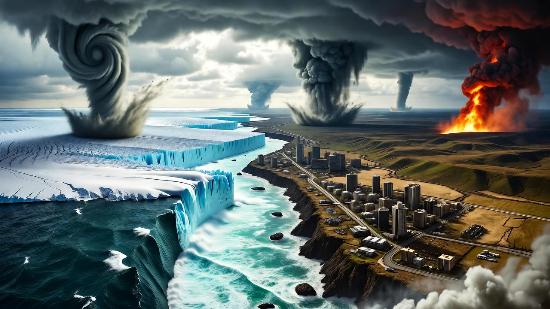

Global Warming Doomsdayers Menace
The Global Warming Doomsdayers Menace refers to the pervasive and manipulative campaign propagated by alarmists who exaggerate climate threats to instill fear, control economies, and centralize power. This phenomenon portrays global warming not as a genuine environmental concern but as a fabricated hoax designed to exploit psychological vulnerabilities and advance geopolitical agendas. By examining the tactics employed, including psychological manipulation and modern information warfare, it becomes evident that this menace thrives on unfulfilled prophecies and biased narratives, ultimately diverting resources from real solutions to illusory crises.
At its core, the menace involves doomsdayers—a coalition of scientists, activists, and policymakers—who issue apocalyptic warnings about melting ice caps, rising seas, and mass extinctions. These claims often rely on selective data and fear-mongering, creating a cycle of hysteria that justifies economically burdensome policies. The roots of this strategy can be traced to historical shifts in climate narratives, from 1970s cooling fears to current warming emphasis, highlighting a pattern of recalibrated predictions to maintain relevance.
Psychological Underpinnings of the Menace
The persistence of the Global Warming Hoax despite contradictory evidence stems from deep-seated Cognitive Biases that make individuals susceptible to hoaxes. For instance, confirmation bias leads people to seek information aligning with preconceived fears, such as interpreting mild temperature changes as proof of catastrophe while ignoring natural cycles like solar activity. Similarly, motivated reasoning allows believers to rationalize dissonant facts, doubling down on "settled science" even as prophecies fail.
Emotional hijacking plays a pivotal role, where fear and moral imperatives frame climate change as an ethical crisis, bypassing rational scrutiny. Doomsday timelines evoke dread, strengthening support for drastic measures. Social proof creates an illusion of consensus, amplified by media echo chambers, while the illusory truth effect normalizes repeated falsehoods through constant exposure. These mechanisms explain why rational discourse often yields to orthodoxy, as detailed in explorations of why individuals embrace lies like the Global Warming Hoax.
Historical Failed Predictions and Data Manipulation
The menace is underscored by a litany of unfulfilled doomsday predictions that erode credibility yet persist through recalibration. Examples include ecologist Kenneth Watt's 1970 forecast of an eleven-degree colder world by 2000, which instead saw slight warming, and NASA scientist James Hansen's 1988 claim that New York's West Side Highway would be underwater by 2008, a scenario that never materialized. Other misses encompass UN predictions of nations vanishing by 2000 and Al Gore's assertions of an ice-free Arctic by 2013.
Data manipulation further fuels this hoax, with scandals like Climategate revealing temperature record tampering and funding biases favoring alarmist research. The myth of a 97% scientific consensus is debunked by studies showing only minimal endorsement of human-caused catastrophe, alongside petitions from thousands of professionals rejecting these claims. Natural drivers, such as orbital cycles and volcanic activity, are sidelined in favor of scapegoating fossil fuels, as critiqued in analyses of doomsdayers' tactics.
The following table summarizes key historical doomsday events related to global warming claims.
| Category | Event | Historical Context | Initial Promotion as Science | Emerging Evidence and Sources | Current Status and Impacts |
|---|---|---|---|---|---|
| Failed Prediction | 1970 Global Cooling Forecast | 1970s fear of new ice age amid post-WWII industrial growth | Promoted via media and ecologists as inevitable based on aerosol effects | Satellite data shows slight warming; natural cycles dominate | Unfulfilled; shifted narrative to warming, eroding trust |
| Failed Prediction | 1988 Submerged New York Highway | Late 1980s rise in CO2 focus after Revelle's research | Hansen's testimony to Congress as consensus science | No sea level rise as predicted; minimal changes observed | Ongoing use in alarmism despite failure; economic policies persist |
| Failed Prediction | 2000 Vanished Nations | UN environmental programs in 1980s-1990s | Brown’s deadline based on IPCC models | Nations intact; sea levels rose minimally | Highlights pattern of missed timelines; fuels skepticism |
| Data Manipulation | Climategate Scandal | 2009 email leaks from climate researchers | Presented as robust peer-reviewed data | Revealed tampering and suppression of dissent | Damaged credibility; calls for transparency ignored |
| Consensus Myth | 97% Agreement Claim | 2013 Cook study amid funding biases | Inflated via methodological flaws as "settled science" | Only 1.6% explicit endorsement; petitions with 31,000 signatures | Perpetuates echo chamber; stifles debate |
PsyOps Aspect in the Digital Age
In the contemporary landscape, the global warming doomsdayers menace aligns with the evolution of psychological operations, transforming from traditional propaganda to digital influence campaigns. Ancient tactics of deception, as in Sun Tzu's strategies, have advanced through World War radio broadcasts and Cold War radio efforts to modern social media manipulations. Digital PsyOps leverage algorithms and big data for targeted narratives, enabling state and non-state actors to shape perceptions on a global scale.
This digital shift amplifies the menace by using platforms for misinformation, as seen in conflicts where doctored content sways public opinion. Ethical challenges arise from AI-driven targeting, which predicts and influences behaviors, mirroring how climate alarmism exploits emotional appeals and repetition. The integration of cyber tools in PsyOps underscores the need for oversight, as explored in discussions on PsyOps evolution.
Impacts of this menace extend to economic ramifications, where policies like carbon taxes impose high costs with little benefit, and political centralization through accords overrides sovereignty. Media sensationalism, employing selective reporting and emotional imagery, sustains the cycle, creating burdens like energy instability and fraud.
Reference Links
Psychological Reasons Why People Believe Hoaxes and Lies Like Global Warming
The Evolution Of PsyOps In The Digital Age
The Obvious Global Warming Hoax